True Built Home Guide To Painting

For those of you who choose to do it yourself.

7 reasons not to change your stock
floor plan Seven Reasons

Painting Guide


Cold Weather Painting

The best time to paint is when the weather is warm and dry, with little wind. Obviously, these kinds of days are few and far between during the Fall. As we approach the cold weather months, the hours of the day that are ideal for painting will shorten.

The latex house painting season starts after the last frost in Spring, then runs until about two weeks before the first expected frost in the Fall. Using latex too late in the Fall, or during an "Indian Summer," can cause great stress on the latex paint film. Cool temperatures during application can interfere with curing and cause coalescence problems. Poor coalescence will result in very early paint failure. Also, subjecting a latex paint film to freeze-thaw cycles during the first two weeks of cure may shorten the long-term life of the paint system. This cycling occurs when the temperatures at night dip below the freezing point causing a "thermal shocking" of the latex paint film which may lead to early embitterment.

With this in mind, many turn to oil base finishes at this time of year. Latex painting generally has a low temperature application limit of 50 F. This temperature applies to surface, paint and air. Many make the mistake of starting a latex paint project when it his 51 F. Unknowingly, the siding has not reached this temperature and may contribute to poor coalescence. Also, painting under similar conditions in the latter part of the day may result in wetting agent or glycol bleeding of the latex paint job later, especially when heavy, morning dews are frequent.

Oil based (solvent) finishes are more forgiving in regards to cold weather painting. These finishes cure by oxidation, not coalescence. Cold temperatures will retard oxidation, but are not detrimental to the overall curing of the system. Shake/shingle and oil house and trim finishes will still cure at temperatures as low as 20 F, whereas the lower limit for latex is 40 F.

Even though oil based finishes will tolerate lower temperatures, one still has to watch a couple of key factors. Cool temperatures, along with high humidity, can spell "condensation." Condensation can alter the curing process or change the gloss of the finished paint job, be it alkyd or latex. Temperatures around the freezing point can produce frost formation on the paint job, which can be just as damaging as condensation.

When the mercury starts to drop, be prepared to use an oil based shake/shingle or house and trim finish. Proper coating selection and a little common sense will result in a satisfactory paint job, even though the chill from the north will make it a little unpleasant during application. Application in cold weather may be a little tricky since the paint will not exhibit the same flow and leveling as it did at 70 F. At low temperatures, obtaining film build will be more difficult and brush drag will increase. Care will have to be taken to avoid runs and sags.

Interior House Painting Tips

Want to pay a consultant to help you with your choice?

Need to find the right colors first?

You probably want a classy home interior painting without spending too much money and exerting too much work. If that’s the case you can simply refer to the following tips for interior house painting.

If you will be eager to know these tips for interior house painting, you would come to realize that there is more than just rolling your preferred shade of paint color unto your walls.

Knowing these interior house painting tips will not just make your walls beautifully painted, but these will as well give you great and fantastic ideas on how you can make your painting sessions speedy yet looks professionally done.

The following are the tips for painting the interior of the house. And if you will follow them consistently, it is guaranteed that you can save a good deal of time in your painting session.

First, wash your brush. Just before you start painting, wash your brush in the solvent that you are going to use when you are done with your painting. Like for instance, water based latex. Through this, as you clean the brush when you are done it will easier for you to do so.

Second, wrap the roller or the brush. If you don’t plan to clean the roller or the brush after using it, yet you are planning to do the painting again after a few days. It is suggested that you wrap them inside a plastic bag very tightly and place them inside the freezer.

Third, use either lotion or latex gloves. If you want to keep your hands clean while painting, use latex gloves then. These are great especially when you are using a paint that is oil-based.

However, if you have allergies in using latex gloves, you can apply hand lotion as an alternative. If you apply a thick coat of lotion before you paint, cleaning will only be easier for you when you are done.

Fourth, consider the wet edge problem. Whenever you paint always consider the wet edge problem, then stay away from it. Also remember that painting over a dry edge will make overlap marks.

Fifth, don’t get stingy when buying brushes or roller covers. When you use cheap roller covers, this will only create a fuzzy form on your wall. Also, cheap brushes will only create uneven brush marks. Rollers that come in multi-packs sold a one dollar are not advisable to buy. It is more advisable to prefer better manufactured tools. Be practical in a clever way.

Sixth, get the “blue-tape”. This blue-tape is nothing like a masking tape. This is different from the traditional masking tape which comes in a beige color. The good thing about the blue-tape is that it doesn’t peel that easily. Hence, this will keep you away from possible frustrations when doing the actual painting.

Seventh, be careful not to lose the can opener of your paint. These can openers for paint come as small metal keys. Therefore, they are prone to be lost in any moment of carelessness. Preferably, chain it to a little chunk of wood.

Eight, be clever on the process of your painting. Follow this order: start from the ceilings, to the walls, trimmings, down to the cabinets, then to the doors. Just always remember to start it from the top going to the bottom.

So, these are all the practical tips in doing your interior house painting. Simply, follow these interior house painting tips carefully and you will never meet stress in painting.

Additional Info

Painting your home can be fun for your entire family, especially when you first move in. We let our kids pick their own colors for their rooms, and we even let them do some of the painting. No matter how much fun we had though, I had to keep in mind that a quality job meant picking the right paints for each room and following some interior painting tips like the ones below.

House Painting Tips: Pick the Right Paint for the Job

As you may already know, paints come in different finishes. Each finish has different properties that make it ideal in certain situations. Therefore try matching the right finish for the needs of each room. In our children’s rooms we chose egg shell paints because they look nice and clean up well. Dirty handprints wash right off without messing up the paint. The kids’ rooms were also not very brightly lit so the shininess of the paint helped brighten up the rooms.

Our dining room was a bit small so we chose high gloss paint. All of the light pouring in from the French doors leading onto the patio reflected off the paint and made the room feel huge. Thankfully, the walls were in good shape since high glass paints do have a tendency to show imperfections.

I was going to choose a flat paint for the master bathroom because the walls were slightly worn and a flat finish is good for covering up these problems. However, flat finishes are also notoriously difficult to clean and bathrooms have a tendency to need a great deal of cleaning. Instead, I did some wall patching and chose a semi-gloss. We ended up choosing a satin finish in the kitchen, living room, and hallways even though it’s one of the more expensive choices. This type of finish is very durable which is nice in these busy areas.

Interior Painting Tips

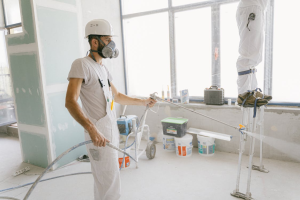
If you do much do-it-yourself work, then you’ve probably already learned the importance of having the right tools for the job. The same is true for interior painting. We started off trying to use a paint sprayer in our bedroom but because of the room’s size it just didn’t deliver the look we were looking for. Once we switched to traditional rollers, the paint job looked beautiful.

Another tip is to make sure you take the time to prepare the walls before you paint. You need to wash the walls thoroughly with a mixture of hot water and mild detergent. Let the walls dry then go through and patch up any sections that are flawed. Make sure you use sandpaper to sand down the patched areas.

Make sure to place drop cloths around the room to protect the floor and carpeting from the paint. No matter how careful you are accidents do happen. It’s a good idea to purchase blue painters’ tape to protect your molding, your door knobs, window frames, light switches, etc. The tape can be removed easily and won’t do any damage.

Don’t forget to get everything you need before starting. Running out of paint in the middle of the job can result in poor quality results and that’s definitely not what you want. If you’re not sure how much paint you’ll need, ask a professional at the paint store for advice. And remember if you’re in doubt it’s better to have too much paint than not enough.

Exterior House Painting Tips

I will walk you through…


True Built Home family

True Built Home
A Better Way, A Better Home


Subscribe E-mail:

To receive our newsletter

<